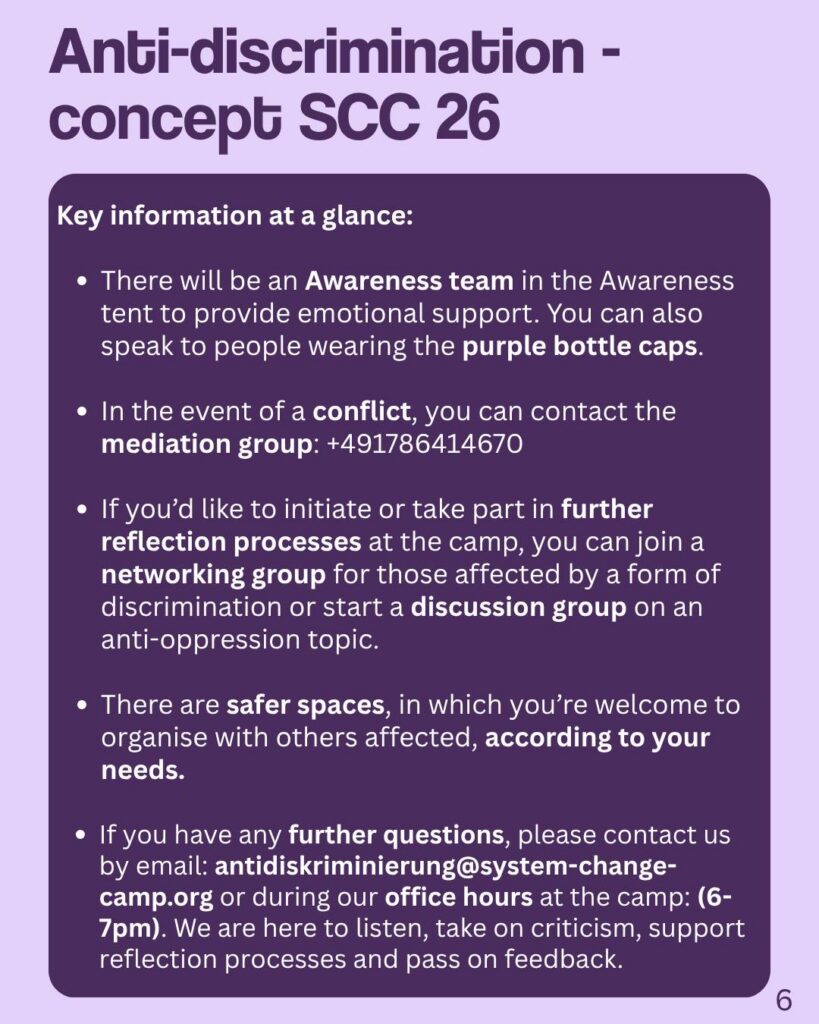
Key information at a glance:
- If you have any questions about breaking down barriers, you can find more information here:
- In cases of acute discrimination or boundary violations, please feel free to contact the Awareness team for emotional support. The Awareness team can be found in the Awareness Tent (see Camp Map).
- If you’d like to create a space at the camp for your community or for others affected by the same forms of discrimination, you can use the Safer Spaces for this purpose.
- If you’d like to have support in resolving conflicts, you can contact the mediation group at the camp (mobile number to follow).
- If you’d like to initiate or take part in further reflection processes at the camp, you can join a networking group for those affected by discrimination or start a discussion group on anti-oppression topics.The networking groups for those affected by discrimination are discussion groups and can already be joined before the camp via signal groups that you can find in the (free) camp registration form.
- If you’d like to get involved in our working group, please feel free to contact us at . We’d love your support!
-
Here’s how to get in touch with us:
-
Before the camp: Email us at . We’ll try to reply as soon as possible.
-
During the camp: We will be available during consultation hours (6–7pm) at the Accessibility/Anti-Discrimination tent to listen, take on board criticism, support reflection processes, and pass on feedback to other working groups and into the planning for the next camp.
-
Summary of the Anti-Discrimination Concept
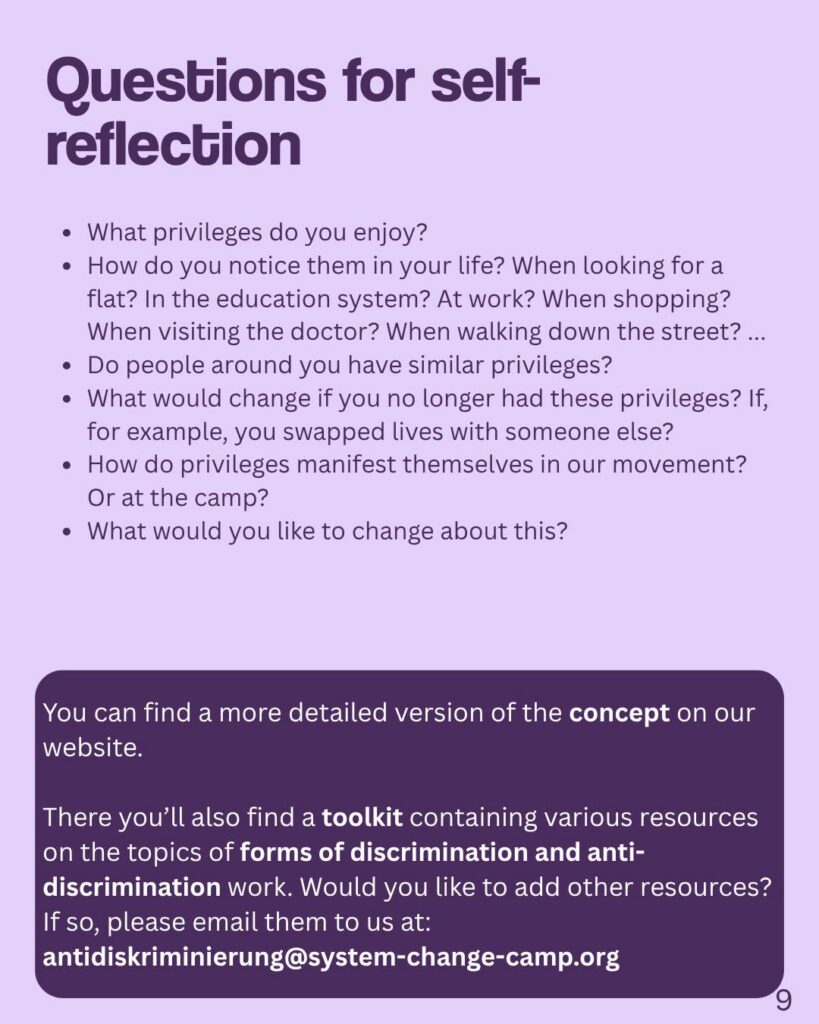
Full version of the anti-discrimination concept
What is discrimination?
We speak of discrimination when disadvantage, exclusion or abuse/harassment occurs on the basis of fundamental affiliations or attributes. These include, for example: anti-semitic attributions, physical appearance, disability and chronic illnesses, caregiving responsibilities, gender and gender identity, weight, age, racist attributions, religion and worldview, sexual identity, social status, etc. Furthermore, discrimination can also manifest itself in subtle ways: In downgrading statements that make generalisations about a group. In statements that are not clearly definable because their meaning may be ambiguous. In jokes or satire that are supposedly not meant seriously, but which can cause harm. For discrimination to occur, those affected do not need to be present or directly targeted.
In all the examples mentioned here, it is not the intention but the effect that matters. This means that even if a remark or action was not consciously intended to be discriminatory, it can still have a harmful effect. Carelessness, ignorance, thoughtlessness, or remarks and behaviours that have until now been taken for granted can therefore also result in discrimination.
Most of us are affected by discrimination. Some to a lesser extent, others to a greater extent and/or on multiple levels. Some enjoy multiple privileges. Most of us also engage in discriminatory behaviour, whether consciously or unconsciously, as we have grown up and been socialised in a society characterised by hierarchies and oppression, and we reproduce (repeat) these behaviours and ways of thinking. This has been and continues to be the case at the SCC, and we want to work against it.
The System Change Camp is a space for everyone who refuses to accept the way society functions and who wants to work towards a fairer and freer world without oppression, exploitation and discrimination. The camp aims to provide a space to strengthen the movement and, through shared discussion, reflection and care, to learn how we can tackle oppression both within and outside our groups.
We would ask both ourselves as organisers and all camp participants to take the time to support and foster these processes before, during and after the camp.
In practical terms, this means the following at the camp:
For people affected by discrimination:
We want to make it clear that the camp is not a ‘safer space’. As in the rest of German society, the camp is also dominated and shaped by a white, non-disabled, non-migrant, non-Muslim, non-Jewish, cisgender and otherwise privileged majority, and, as a result of this socialisation, is not free from discrimination. The camp’s open nature, as well as its size and short duration, do not allow us to counteract this sufficiently.
Nevertheless, we wish to work to counteract discrimination as far as possible both in the run-up to the camp and whilst it is taking place: we want to initiate processes of reflection and solidarity, whilst at the same time offering structures that enable an empowering and self-determined approach to dealing with cases of discrimination.
To this end, we have put the following structures in place:
- Prevention & awareness-raising regarding discrimination:
- Prioritising marginalised perspectives and anti-oppression themes in the programme.
- Sharing this anti-discrimination policy with all contributors, via posts before the camp and notices displayed at the camp.
- Awareness Team: There is an Awareness Team at the camp which you can contact; they will support you as best as possible in a way that is centred on those affected.
- Safer Spaces: there are 7 tents available at the camp for Safer Spaces. You can also write on the outside of any tent to specify your exact needs for the duration of your stay.
- Chill tent for everyone
- Quiet tent for everyone
- ARA (affected by racism and/or antisemitism) Safer Space
- Disability Safer Space
- Neurodivergence Safer Space
- FLINTA* Safer Space
- 1 tent available for general use. If you wish to use it, please write on the sign outside the tent who is currently inside and who should (or should not) be allowed in. Please also be mindful of the needs of other groups and try to coordinate its use through mutual discussion
- Networking for those affected & anti-authoritarian discussion groups:
- The ‘Networking for those affected’ sessions are meetings where people who have experienced discrimination can share their experiences and initiate processes of reflection. You can also join a ‘Networking for those affected’ group before the camp begins. You can find Signal groups for these in the registration form.
- On the one hand, the meetings are intended to provide a space to discuss experiences of discrimination at the camp and to offer mutual support. On the other hand, the meetings are designed to enable a self-determined approach and a channel for feedback to the camp: your thoughts and processes can be passed on to the entire camp by two delegates via the so-called cross-group meetings. For example, it could be suggested that all groups read specific texts or a statement on forms of discrimination at the camp. A toolkit containing various materials and methods is available for this purpose.
- Furthermore, people who are not affected by (certain) forms of discrimination are invited to engage with these issues in discussions that challenge systems of power. Examples might include discussions on critical whiteness, critical masculinity or class privileges.
- Toolkit with resources and methods on forms of discrimination: A collection of resources and methods for reflecting on discrimination, both on-site and online, is available; this can be used, expanded and shared by anyone at any time. If you’d like to add resources, please feel free to email them to us at: . Furthermore, networks representing those affected may suggest using specific resources and methods if they notice a particular need for them at the camp.
You can find the Toolkit here: https://cryptpad.fr/pad/#/2/pad/view/dzGuAYKxVFdoCNpqmyY1VJNUYij97wY6uiEve+T4EfI/ - Contact details and feedback options for the Anti-Discrimination Working Group: You are welcome to send us feedback by email () before, during and after the camp, and you can contact us directly at the camp during our consultation hour at the camp (6.00–7.00 pm). During these consultation hours, we are available to listen, take on board criticism, support reflection processes, and pass on feedback to other working groups and into the planning for the next camp. If you need emotional support, please feel free to contact the Awareness team. If you need help resolving conflicts, please contact the Mediation Group at the camp. Telephone Number: +491786414670
For people who are privileged in certain areas
e.g. white, non-disabled, non-migrant, non-Muslim, non-Jewish, non-Sinti* and non-Roma*nja, cisgender, conventionally attractive and people who are privileged in other ways. If you don’t understand any of these terms, you’ll find explanations at the very bottom.
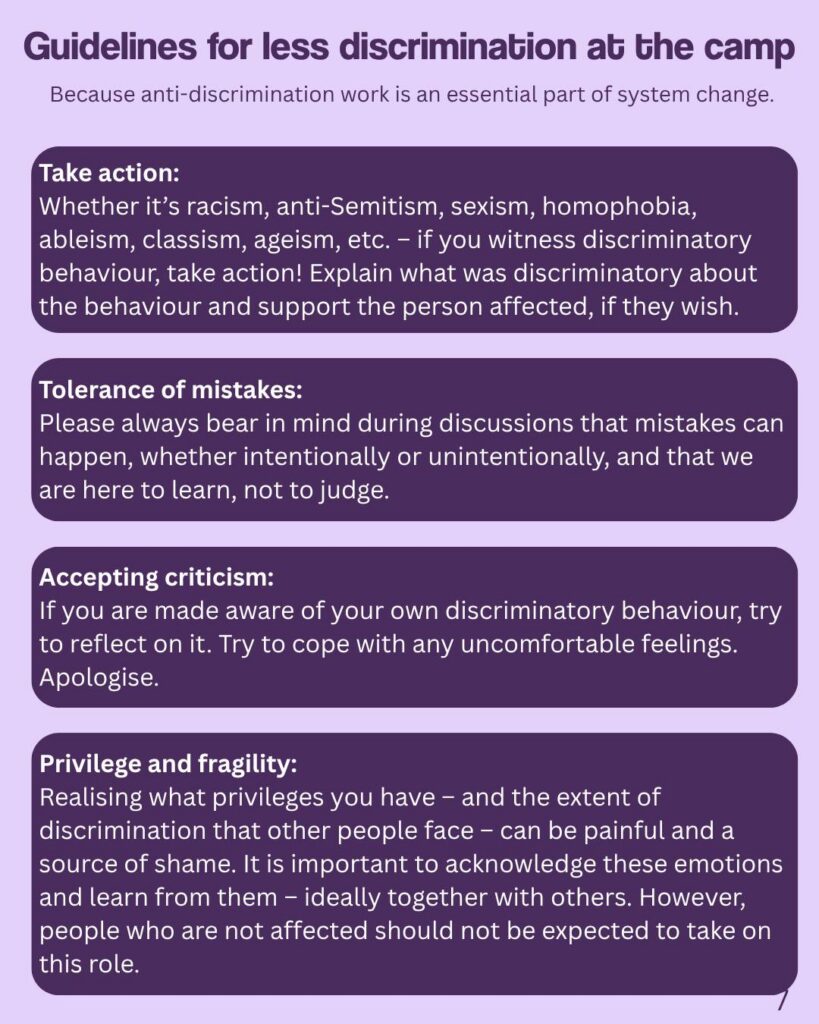
- Intervene: Whether it’s racism, anti-Semitism, sexism, queerphobia, ableism, classism or ageism – if you witness discriminatory behaviour, take action! Support the person affected and challenge what has happened. In such cases, neutrality merely perpetuates discriminatory behaviour or statements and, for those affected who constantly have to respond to discrimination, it lacks solidarity and is isolating. This may mean interrupting people who are speaking. Anyone in the room can step in if a form of discrimination is being perpetuated.
- Avoid paternalism: It is important to intervene in cases of discrimination, but please take care not to act in a patronising manner towards those affected; instead, let them speak and decide for themselves.
- Paternalism describes a situation where a person in a position of greater power makes decisions for others, supposedly for their own good. This ‘patronising’ occurs without sufficiently involving those affected or allowing them freedom of choice. Paternalism implies an imbalance of power, in which the ‘higher’ authority believes it knows better what is good for the ‘lower’ authority.
- Accepting criticism: If you are made aware of your own discriminatory behaviour, acknowledge your feelings – such as defiance, hurt or anger. However, do not act towards the person affected based on these feelings; instead, find ways to manage them and do not confront those affected with your feelings. Try, together with others who may be familiar with this form of discrimination, to understand what was discriminatory about your behaviour and how this can be changed. Do not forget: it is not you who have been hurt. Your discriminatory behaviour does not make you a bad person; rather, it is a product of being socialised in a discriminatory society.It is your responsibility to unlearn this behaviour and to counteract discrimination. Try to endure any uncomfortable feelings. Apologise. Accept it if those affected wish to withdraw from the situation because they do not want to expose themselves to further hurt.
- Tolerance of mistakes: In our conversations and when intervening, we must always be mindful that mistakes can happen, whether consciously or unconsciously, and that we are here to learn, not to judge.
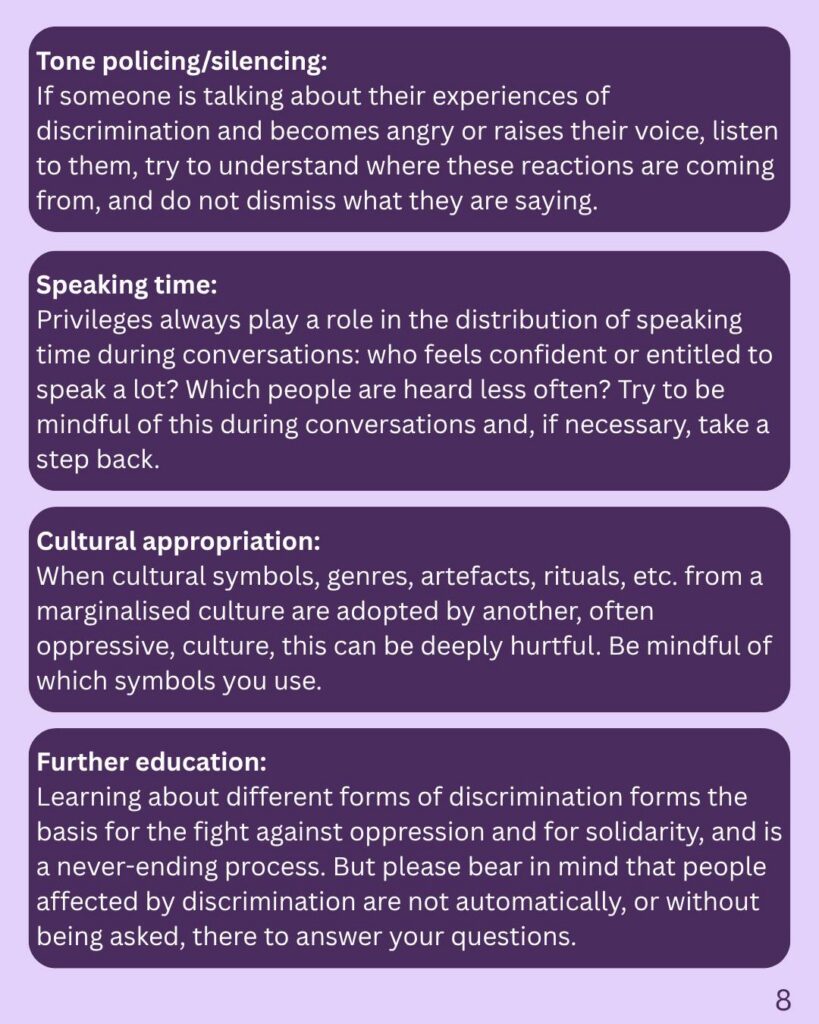
- Speaking time: Privilege always plays a role in the distribution of speaking time in conversations: who feels safe or entitled to speak at length and loudly? Which people are heard less because their perspectives, appearance or language do not correspond to those of the majority? Which perspectives have more space in society – for example, are they regularly shown on television? Which ones do not? Which perspectives are not so well represented at the camp? Try to bear these reflections in mind during conversations and ensure that speaking time is distributed fairly. Particularly when it comes to discrimination: give more space to those affected who wish to share their experiences, and step back if necessary. Take care not to make assumptions based on a person’s appearance as to whether they have experienced discrimination and wish to talk about it. Not all forms of discrimination are visible, and not everyone affected wishes to share their experiences of them.
- Further education: Learning about different forms of discrimination forms the basis for the fight against oppression and for solidarity, and is a never-ending process. However, it is important to remember that people affected by discrimination are not automatically, and without being asked, expected to answer questions from those not affected by that form of discrimination. If you are not affected by a particular form of discrimination and have questions about it, it is better to do your own research or discuss it with others who are not affected.
- Privilege and fragility: When you realise what privileges you have, or become aware of the extent of discrimination other people face, this can be painful and/or cause feelings of shame. It is important to feel these emotions, to understand where they come from, and what you can learn from them – ideally together with others. However, those affected should not necessarily have to take on this role without being asked. People affected by discrimination experience it on a daily basis – something those not affected may only just be becoming aware of – and may not want to be reminded of it or have to take on the additional burden of looking after those not affected.
- The term ‘fragility’ is used to describe a defensive stance, denial, belittling, or emotional disengagement that privileged people may exhibit in response to mentions of discrimination. For example, the term ‘white fragility’ is used to describe the defensive reactions that white people display when confronted with racism. ‘White fragility’ is characterised by emotions such as anger, fear and guilt, as well as by behaviours such as argumentativeness and silence.
- Tone policing/silencing: When a person speaks about their experiences of discrimination and becomes angry or raises their voice, listen to them, try to understand where these reactions are coming from, and do not dismiss what they are saying.
- Definition: Tone policing is a conscious or unconscious discussion strategy or diversionary tactic in which the focus is not on the content of what is said, but rather on the person’s tone of voice. People affected by discrimination often find themselves in a position where they must repeatedly negotiate their right to exist and their humanity in order to be seen and heard. Emotions such as anger, frustration or fear are important reactions to unjust and life-threatening situations. The demand to distance oneself from the injustices one has experienced whilst remaining objective is an expression of unequally distributed power.
- Generalisations: Do not use the example of one person affected by a particular form of discrimination to speak about or include all people affected by the same form of discrimination. This amounts to homogenising and reducing all these people to their experience of discrimination, thereby dehumanising them. (e.g.: do not say: “It’s not that bad, because I know someone who’s affected by it and it’s fine for them”)
- Tokenism: When working in groups, take care not to exploit people affected by discrimination for the sake of token participation. Be transparent about the experiences of discrimination and privileges within your group, and consider how you can best work together from your respective social positions.
- Definition of tokenism: Tokenism refers to the practice of visibly including individual members of an under-represented group, primarily to convey an impression of diversity or equality – without these individuals actually being involved on an equal footing or any structural changes taking place. E.g.: A school invites a single person with a disability to a panel discussion to demonstrate diversity. However, their perspectives are barely taken into account during the discussion, and they are not involved in future decisions regarding accessibility.
- Cultural appropriation: Cultural appropriation refers to a process whereby cultural symbols, genres, artefacts, rituals and/or technologies from a marginalised culture are used or adopted by members of another culture. This ‘taking things out of context’ – often linked to hierarchies, financial gain and exploitative relationships – can be deeply hurtful to people whose culture is being appropriated. Through appropriation, their culture is rendered invisible, devalued and, at the same time, further exploited.
- Example: White Locks: For many Black people, dreadlocks hold political and historical significance as a symbol of resistance against racism and white beauty standards. When white people wear this hairstyle without taking this history and the existing power dynamics into account, it is often painful for Black people. The issue is that white people profit from or receive recognition for a Black symbol of resistance, whilst Black people often face discrimination for wearing the same hairstyle. This can depoliticise the symbol’s original meaning and render the experiences of the affected community invisible.
To conclude, here are a few apt words from Lilla Watson, an activist from the Murri (Aboriginal communities in Queensland and northern New South Wales), on the right attitude to adopt in struggles against oppression:
“If you’ve come to help me, you’re wasting your time. But if you’ve come because your liberation is linked to mine, then let’s work together.”
Further information/explanations of terms
If you’d like to know more about different forms of discrimination or are unsure about certain terms,
you can read more here:
- Abolitionism
- Allyship
- Anti-Bias-Approach
- Being Priviliged
- BIPoC
- Colorblindness
- Colorism
- Diaspora
- Empowerment
- Eurocentrism
- Gaslighting
- Intersectionality
- Majority society
- Microagressions
- Othering
- Postcolonialism/ Postcolonial Theory
- Racial Justice
- Racial Profiling
- Safe(r) Spaces
- Self-designation
- Stereotyping
- Tokenism
- Tone Policing
- Triggerwarning
- White Fragility
- White Privilege
- White Supremacy
- Individual racism
- Institutional racism
- Antiasian racism
- Antimuslim racism
- Anti-Black racism
- Antigypsyism/Antiziganism
- Ableismus
- Ageism
- Classism
- Cyberbullying
- Heteronormativity
- Islamophobia
- Lookism
- Multiple Disrcimination / Intersectionality
- Racism
- Sexism