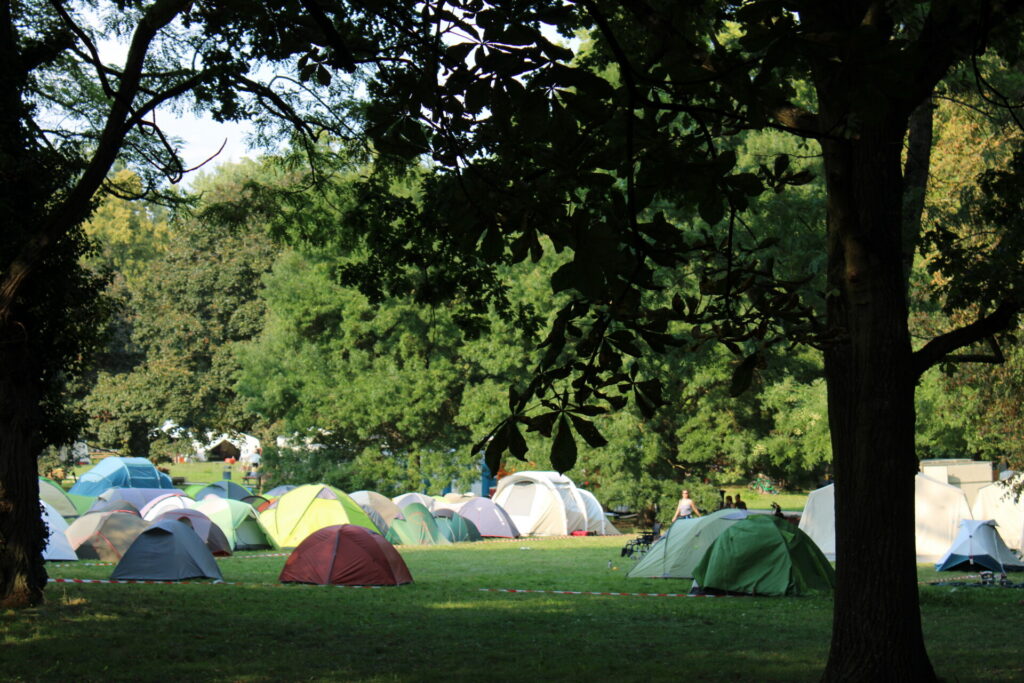
The reason for this is the desire for flatter hierarchies, greater sharing of responsibility, and more experiences of self-efficacy for everyone at the camp. The SCC is meant to be a space shaped and sustained by all of us, where we can collectively turn our ideas about living, communicating, and working together into reality, at least to some extent.
Since we were socialized in a society rife with discrimination, competition and capitalist exploitation, we often unconsciously reproduce these very patterns. That is why systemic change involves not only taking action outwardly but also reflecting on how we treat one another. The SCC aims to provide a space for this and to encourage mindful interaction, mutual care, and self-reflection through practical coexistence with hundreds of people—most of whom are strangers.
However, this is often difficult in large groups. In recent years, there has often been a diffusion of responsibility and an unfair distribution of the reproductive labour as cleaning restrooms, cooking, or childcare that keeps a camp running. That’s why this year, everyone at the camp should organise themselves into smaller groups, which we call “Haufen.” The term comes from the “Bauernhaufen”—alliances of farming communities that existed primarily during the German Peasants’ War (1524–1526). These groups fought for greater representation in secular and ecclesiastical bodies, the abolition of serfdom, the reduction of high taxes imposed by landowners and monasteries, and the expansion of local autonomy.
What Are "Haufen" and What Do They Do?
- There are 8 “Haufen”, which form smaller organizational units at the camp. Each “Haufen” will consist of about 50–100 people who will organize themselves collectively.
- This is not about the physical layout of the camp, but solely about organization.
- The “Haufen” are assigned various tasks that originate from different working groups of the SCC and will be distributed collectively. Each “Haufen” is responsible for theire tasks—there aren’t more tasks than usual; they’re just distributed differently.
- The “Haufen” meet every morning for a assembly (“Haufenversammlungen“). These will replace a workshop slot. Part of the meetings will be devoted to organizing tasks and camp updates, while the rest is intended for self-organization and autonomous discussion within the groups.
- In addition, there will be time for comprehensive meetings (“haufenübergreifende Versammlungen”), where current camp issues can be discussed or participants can network on specific topics.
- More information about the meetings will be provided when the timetable is published.
How exactly are reproduction tasks organized?
- There are two different types of tasks: “Haufen”/working group-specific tasks and comprehensive tasks.
- specific tasks include, for example, cleaning up the equipment tent (Materials & Logistics “Haufen”), handling press relations (Public Relations “Haufen”), or closing all tents in the evening (Tent “Haufen”)—that is, tasks for which a specific group is responsible. Some of these tasks require more training and should be handled by people committed to them for a longer period of time.
- comprehensive tasks require so many people per day that they are distributed across all “Haufen”. These tasks include chopping, washing dishes, and other kitchen duties, as well as assisting and doing night and day security shifts. Each “Haufen” will assign people to these tasks daily.
- Tasks are assigned every morning during the assembly (“Haufenversammlung”). Instead of working through shift schedules alone at the information desk, this is now done collectively within the group. Tasks for which people take on long-term responsibility are also assigned in the assembly.
- The comprehensive tasks are adjusted daily and tailored to each “Haufen”—so that the work is distributed evenly among all “Haufen”.
How do I join a "Haufen"?
- When registering online, all participants receive information about the “Haufen” and can assign themselves to one. The goal is for as many people as possible to register.
- Camp Start: Upon arrival—regardless of when that is—all camp participants should choose a “Haufen” if they haven’t registered beforehand. Starting on the first day that a significant number of people are present alongside the organizers, the “Haufen” will meet daily.
- Each day, there will be brief onboarding sessions for new arrivals. Even people who are only at the camp for a short time (e.g., just for a weekend) are asked to participate.
- Day visitors are welcome to join the “Haufen” assemblys, provided they arrive in the morning. This way, they can become part of a “Haufen” for the day. If day visitors arrive later, they can find out about open volunteer shifts at the Info Point or at a “Haufen’s” designated post and help out there on the spot.
Partition of "Haufen"
The “Haufen” listed here organize themselves collectively: they onboard new members, facilitate their daily group meetings, send members from their group to cross–group meetings, and take on cross–group tasks. Unfortunately, only the interpretation group can provide interpretation services. Nevertheless, people who don’t understand German are welcome to join any of the other “Haufen” as well. In those “Haufen”, we rely on whispered translation.
The following descriptions of the “Haufen” can be expanded and collapsed.
"Haufen" descriptions
The Collectivisation "Haufen"
Here you can expect tasks such as childcare, running the information point and the information pavilion for passers-by, and we want to work together to make the camp a cosy place! The Collectivisation Working Group will be represented in this “Haufen”.
The Anti-Discrimination and Accessibility "Haufen"
Here, you can expect tasks designed to make the camp accessible to as many people as possible. These include, for example, being available to address anti-discrimination issues during office hours, supporting the hybrid and online programme, translating the ticker into plain language, raising awareness during programme points where FFP2 masks are required, or marking out routes and identifying trip hazards. We’re also very keen to welcome people who don’t yet know much about discrimination and barriers. The Accessibility Working Group and the Anti-Discrimination Working Group will be represented in this “Haufen”.
The Food Supply and Tents "Haufen"
Here, your tasks will include organising the food supply (not the repro shifts themselves, which are covered by a people across multiple “Haufen”).
On the other hand, we look after the tents. Tasks you can expect here include: doing an evening round of the camp to close the tents, keeping an eye on the weather, retightening tents where necessary and securing storm lines if required. You do not need any prior experience for this. The Tents Working Group and the Food Supply Working Group will be represented in this “Haufen”.
The Materials & Logistics and Awareness "Haufen"
Here, you can expect tasks such as driving, including large vehicles (a driving licence is required), setting up and clearing away equipment tents, sourcing equipment, taking camp-related orders from other participants, searching for second-hand items online, organising shopping trips, and organising waste management and waste collection shifts. You’ll also be planning the dismantling process – deciding what goes where – and there’ll be plenty of opportunity to share skills on transport logistics relating to camps and the ‘Camptrail’. In addition, you’ll organise emotional first aid, advise camp participants on the awareness concept, and produce and distribute purple bottle caps. The Materials and Logistics Working Group and the Awareness Working Group will be represented in this “Haufen”.
The Public Relations and Security "Haufen"
Here, you can expect tasks such as speaking to the press, providing camera support, communicating within the camp, and creating posts and press releases. You should be keen to get involved in processes and external communications over the longer term.
In the Seekuh part, you can also expect to take on coordination tasks for night and day shifts, as well as organisational duties that arise on site in the Seekuh area. Mindfulness and a firm yet de-escalating manner are helpful. Our aim is to ensure that everyone taking part in the SCC can enjoy a pleasant and relaxed time together. Shifts will also be filled across different Haufen. The Seekuh working group and the Public Relations working group will be represented in this “Haufen”.
The Program and the Electricity & Technology "Haufen"
In the Program Working Group, there are tasks that require varying amounts of training. Tasks that can be carried out without a lot of training include, for example, supporting speakers and artists, counting participants in workshops, looking after the program board, or restocking facilitation materials in the tents. For tasks that involve greater responsibility for processes and therefore require a little more training, you should be at the camp for at least 4 days. These tasks include various infrastructure duties, writing updates for the live feed, being available to answer questions at the program tent during opening hours, managing emails, coordinating Program Working Group processes, office work, checking feedback, being on hand to assist the external tents, and managing finances.
There will also be tasks relating to electricity and technical support: handing out technical equipment to speakers and, if necessary, carrying it to where it’s needed; setting up equipment such as projectors and microphones; possibly helping out at concerts and talks; orienting solar panels towards the sun; and, with a theatrical ‘end-of-the-world’ air, snatching people’s electric kettles and fans from them before the power grid completely collapses. The Tech and Electricity Working Group and the Programme Working Group will all be represented in this “Haufen”.
The Water and Shit "Haufen"
Here, you’ll be tasked with managing the camp’s water infrastructure and toilets. These tasks include organising the shit brigade and maintaining the sanitary facilities. Don’t worry, you won’t be spending all your time scrubbing toilets; instead, you’ll be briefing the daily shit brigade crews based on existing how-to guides. You’ll keep track of when the portable toilets need emptying or when cleaning supplies need restocking. This “Haufen” also looks after the drinking water and wastewater infrastructure: dealing with pump emergencies, repairing water leaks or optimising the pipework system. To ensure a smooth organisation and effective knowledge transfer regarding the infrastructure, it’s best if you spend several days at the camp. We’re particularly keen to hear from people who can help with setting up and dismantling! No prior knowledge or hands-on experience is required! Everyone is welcome. The Water and Shit Working Group will be represented in this “Haufen”.
The Interpreting "Haufen"
Tasks here include managing interpreting equipment, being available to interpreters and those who need interpreting, and facilitating communication regarding interpreting. This “Haufen” will be interpreted into English, French and German. That’s why this “Haufen” is particularly open to international participants and encourages international networking. The Interpreting Working Group will be available in this “Haufen”.